Artist
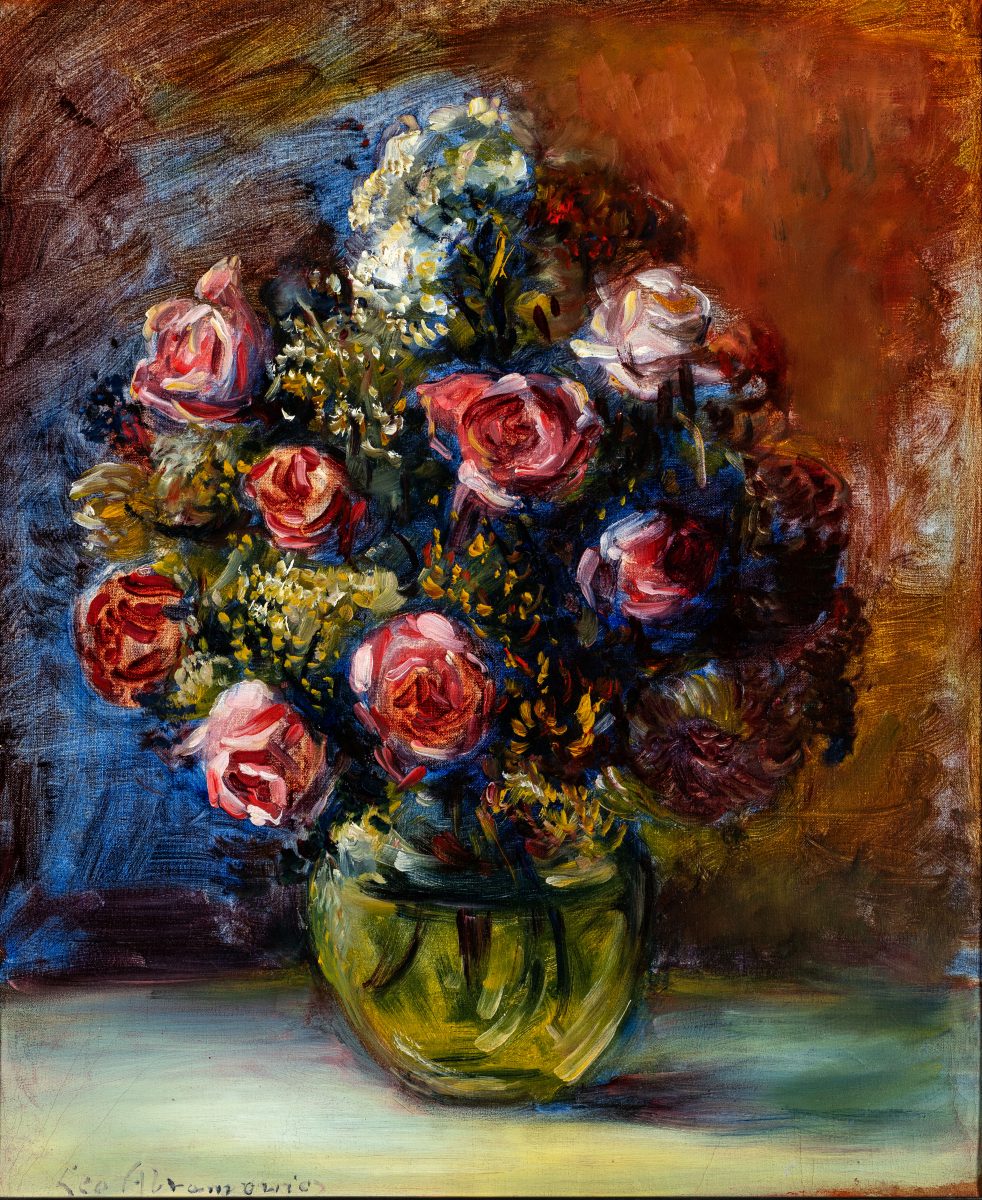
Still Life with Roses
|
no date
Abramowicz, Leon
1889
Chernivtsi (UKR)
-
1978
Vienna (AUT)
The artist Leon (Leo) Abramowicz signed only a few of his works, one of which found its way into the Böhme Collection. “I am not a flower painter”, the artist said of himself, yet he created a considerable number of paintings with bouquets, such as Still Life with Roses and Apples (1922), shown here.
Abramowicz was born into a wealthy Jewish family in Chernivtsi, which was part of Austria-Hungary until 1918. After a short period of training in Vienna, he moved to Munich, where he studied at the prestigious Royal Bavarian Academy of Fine Arts from 1912 to 1914. The following period was marked by travels to Switzerland and France, during which he searched for his own personal style. In 1915, Abramowicz was called up for military service in the First World War. After the war, he returned to Vienna, where he was a master student of Karl Sterrer (1885–1972) from 1933 to 1935 and quickly made a name for himself as a portrait painter in the Austrian capital. Thanks to his background and talent, Abramowicz achieved a measure of wealth and fame.
The now married artist saw his life change abruptly when Austria was annexed by Fascist Germany in March 1938. The fact that many Jews remained in the city for so long, even as the fate of German Jews became clearer, is indicative of the uncertainty and profound changes brought about by the social upheaval. The artist and his wife, Marianne (née Prenosyl, 1907–unknown), were also targeted by the Gestapo. Their apartment in the First District was ransacked on 24 May 1938, and not only were furniture, paintings from Marianne’s art collection and Leon’s works looted, but important documents and personal papers were also destroyed. A few days earlier, Abramowicz had fled to Switzerland with the intention of reaching Paraguay, while Marianne was forced to remain in the now empty apartment until January 1939.
After the outbreak of war in 1939, the couple moved into a small attic room in Fontaine, France – a meagre shelter that served as a refugee accommodation. Although they were able to apply for a residence permit as “victims of Nazi Austria”, they were given just forty-eight hours to find a place to live. In such a short time, they were only able to find one bare room. In addition to their precarious living conditions, they lived in constant fear of betrayal and attack. The couple sold jewellery and paintings and eventually decided to flee again. For years they searched desperately for housing, food and clothing until Marianne was captured in July 1943 and deported to the Gurs internment camp on the Franco-Spanish border. Leon was arrested during a roundup in August and sent to a camp in Toulouse. Through a contact with the Jewish Refugees Committee, they managed to escape. They survived in hiding until the liberation of France by the Allies.
In 1950, the artist moved back to Vienna, where he became reclusive, marked by his experiences of flight, looting and anti-Semitism. While little is known of Marianne’s post-war life, painting remained important to Leon. In addition to his own artistic work, he enrolled as an auditor at the Vienna Academy of Fine Arts in 1956–57. This led him back to a creative environment and further artistic development. Further information can be found in our collection catalogue ”You will not be forgotten. The Lost Generation. Their Art. Their Stories."
artworks
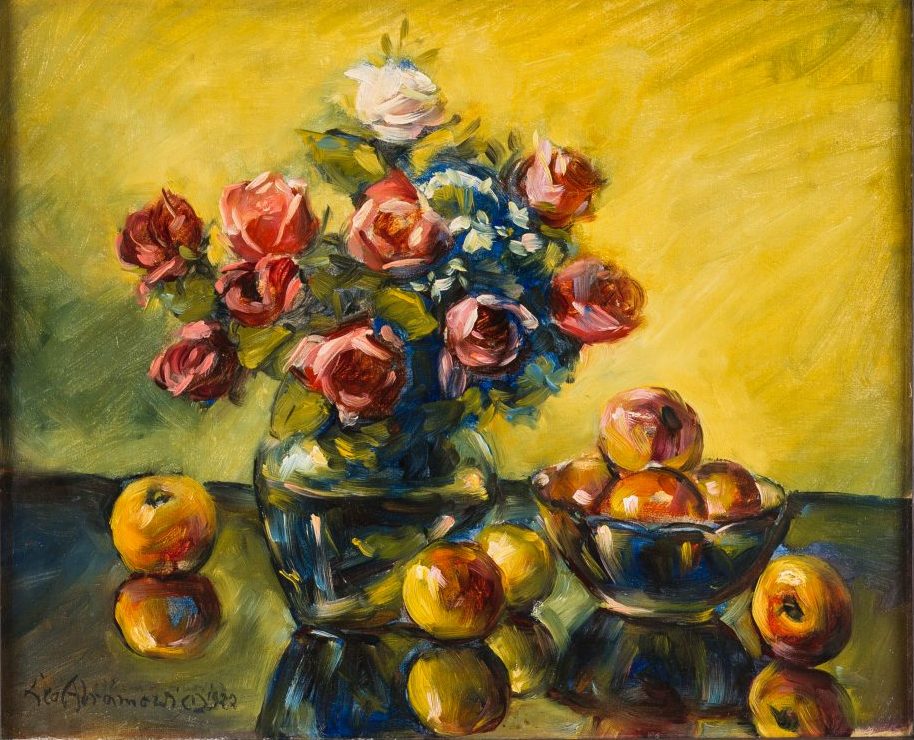
Still Life with Roses and Apples
Oil on canvas
45 × 55 cm
1922
Abramowicz, Leon
|
Still Life with Roses and Apples
1922
Oil on canvas
45 × 55 cm
Still Life with Roses
Oil on canvas
58,4 × 54 cm
o. D.