Artist
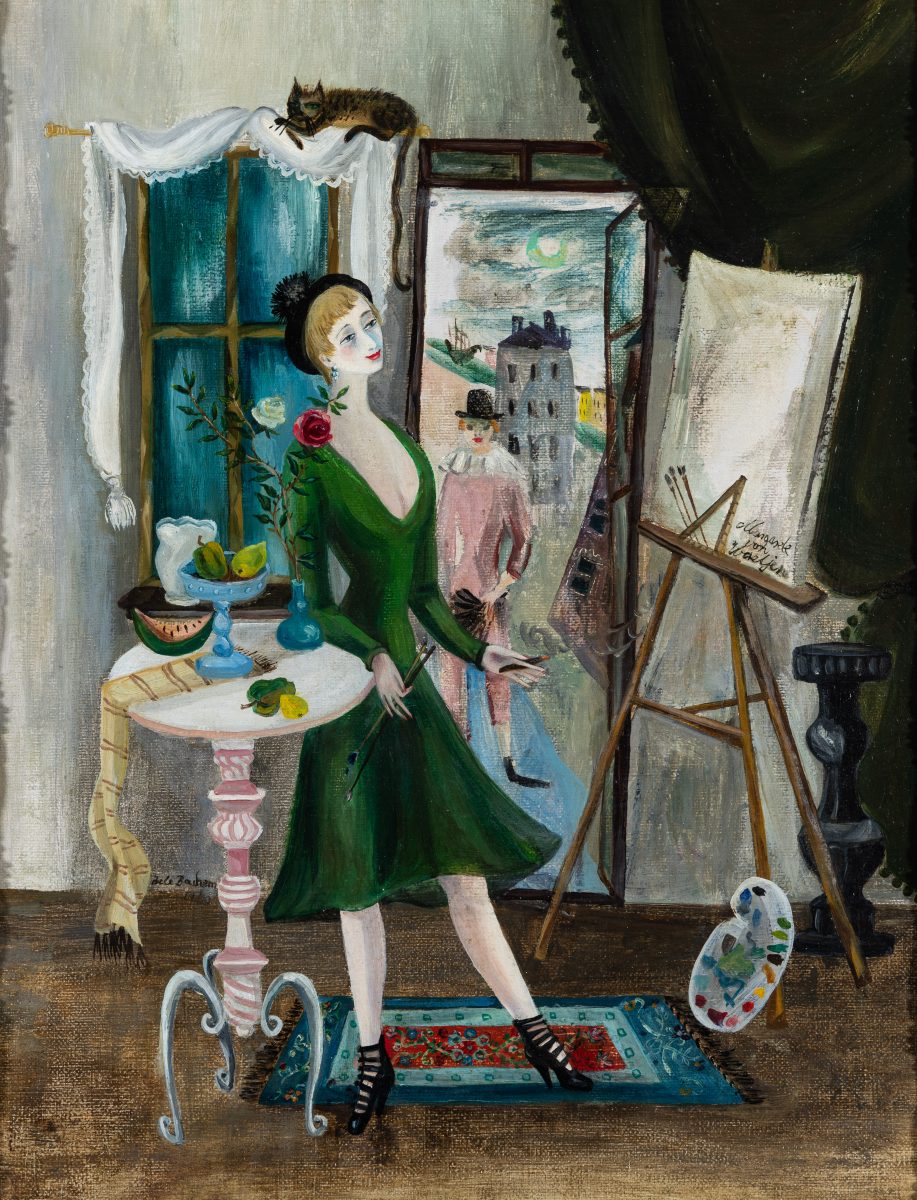
Portrait of Margarete von Waetjen
|
1950
Bachem, Bele
1916
Düsseldorf (DEU)
-
2005
Munich
Renate Gabriele Bachem, nicknamed Bele, was the daughter of Hedwig Bachem and the painter Gottfried Maria Bachem, a former student of Max Liebermann. She picked up on her father’s artistic creativity, but their personal relationship was anything but good. Bachem studied from 1934 to 1940 at the School of Arts and Crafts in Gablonz an der Neisse, which from 1938 to 1945 belonged to the Reichsgau Sudetenland. She also attended the Berlin Academy of Arts and studied with Ludwig Bartnig, Max Kraus and Georg Walter Rössner. Bachem, however, never committed to a particular art movement and quickly developed her own style.
In 1937 she produced her first illustrations for magazines, such as "Die Dame" (The Lady) and "Elegante Welt" (Elegant World). In 1940 she married the art historian Günter Böhmer. In the same year, her daughter Bettina was born. In 1943, she came to the attention of director and head of the state theatre Otto Falckenberg. Through him, Bachem received commissions as a stage designer at the Munich Kammerspiele, for productions such as "Minifie" by Hans Hoemberg (directed by Wolfgang Petzet).
Her often bizarre designs lead to heated discussions. Bachem's art walks the line between semi-reality and surrealism. While Falckenberg was included in Hitler's 1944 list of “divinely-gifted” and irreplaceable artists, Bachem was banned from exhibiting that same year.
After having moved to her parents-in-law in Sonnenburg near Frankfurt an der Oder, Bachem fled East Germany at the end of the war and went to Feldafing on Lake Starnberg. She then separated from her husband and thus moved to Munich in 1947, where she settled permanently. The director Rolf Thiele, who had just released his socially critical film "Das Mädchen Rosemarie" (1958), set about making his first major colour film "Die Halbzarte" in 1959. In addition to Romy Schneider and Magda Schneider in the leading roles, he also hired Bele Bachem for the colour designs. She was tasked with linking the decorations, costumes, furnishings and moods of the actors. Bachem's work was well received and the film was shown as the Austrian entry at the Cannes Film Festival. Unfortunately, the script and Schneider's acting lead the film to be quickly forgotten. Bachem never worked for the film industry again after that.In the 1960s, '70s and '80s, Bachem was part of the legendary Schwabing bohemian scene, where she earned her nickname "Schwabing's female Cocteau". From 1950 to 1960 she was an artistic collaborator at the Rosenthal porcelain factory, designing tea sets, vases, furniture and wallpaper. In 1950, she painted the Portrait Margarete von Waetjen (1930 – 2005). The sitter's signature can be read on the canvas in the painting.
From 1965, Bachem once again turned more to painting and graphics. Numerous exhibitions followed in Hamburg at the Galerie Nierendorf, at Lempertz in Cologne, in New York and other places throughout Germany. Bachem eventually retired to Mallorca. Das Kunstwerk "Porträt Margarete von Waetjen" wartet noch auf eine Kunstpatenschaft! Durch die Übernahme einer Kunstpatenschaft profitieren Sie von zahlreichen Vorteilen, wie beispielsweise einer persönlichen Urkunde, die Ihre Kunstpatenschaft dokumentiert, sowie einer detaillierten Objektbeschreibung und Künstlerbiographie. Auf Wunsch wird Ihre Patenschaft zudem bei Ausstellungen und auf unserer Website erwähnt. Und das ist nur ein kleiner Teil der exklusiven Vorteile, die Sie erwarten. Mehr Informationen erhalten Sie here! Weiterführende Informationen finden Sie in unserem Sammlungskatalog „Wir werden euch nicht Vergessen. Die Verlorene Generation. Ihre Kunst. Ihre Geschichten“. Dieser ist here erhältlich.
artworks
Portrait of Margarete von Waetjen
Oil on canvas on board
49,5 × 39,5 cm
1950