Artist
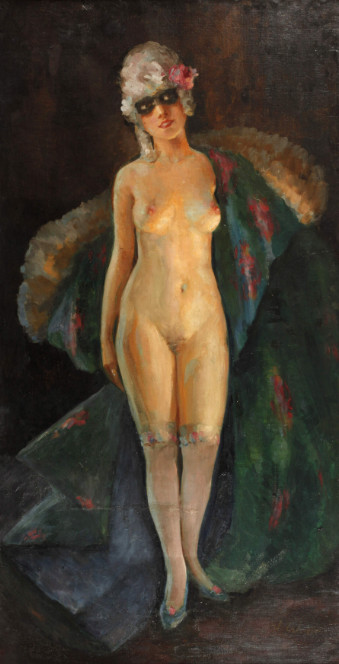
The Sin
|
1931
Breinlinger, Hans
1888
Konstanz (DEU)
-
1963
Konstanz (DEU)
Hans Breinlinger came from a farming family in the state of Baden, but as the son of a second son he was not in line to inherit the farm. He initially did an apprenticeship in photography and photographic retouching at the Vocational School in Constance. Then, from 1906 to 1908, he travelled to Nuremberg, Freiburg im Breisgau, Lausanne, Boulogne, Paris and Stuttgart, working as a photographer. In 1910 he began to study at the Grand Ducal Academy of Arts in Karlsruhe, where he concentrated on landscape and portrait painting in the class of Wilhelm Trübner (1851–1917). In 1918, Breinlinger returned wounded from the First World War. In 1919 he exhibited for the first time at the Breidablick Exhibition in Constance, and in 1921 the Constance Art Association gave him his first solo exhibition. Breinlinger went travelling again in 1923–24, this time for study purposes, to Holland, Italy, Vienna, Paris and London. He married the successful writer Alice Berend (1875–1938) in London in 1926. She was the elder sister of Charlotte Berend-Corinth, the wife of Lovis Corinth (1858–1925). Alice and her husband moved from London back to Berlin. Breinlinger was supported by the art dealers Justin K. Thannhauser (1892–1976) and Alfred Flechtheim (1878–1937). From 1927 onwards, he regularly took part in the exhibitions of the association “Die Juryfreien” in Berlin, and in 1931 joined the committee of the Working Group of Catholic Artists. One year later, he was allowed to exhibit with the Berlin Secession, though he was not a member. He was also represented at the Chicago World’s Fair in 1933. The books by his wife Alice Berend were placed on the list of “un-German literature” by the National Socialists. She was Jewish, and in 1935 she emigrated to Italy to escape persecution by the Nazis.
Breinlinger and Alice Berend were then divorced. In 1937, works by Breinlinger were declared “degenerate art” and banned from the Municipal Wessenberg Picture Gallery in Constance and from the Mannheim Kunsthalle. Nevertheless, Breinlinger was still given numerous official commissions, including one in 1938 for a sgraffito on the front of the hall of the “Reichsstand des Deutschen Handwerks” (the “Imperial Guild of German Crafts”) for the building and housing trade fair in Frankfurt am Main. His other commissions included monumental paintings for churches in Berlin, Brandenburg and Silesia.
Breinlinger’s studio was destroyed when Berlin was bombed on 23 November 1943, after which he returned to Constance. From 1947 onwards, he was active as a committee member and head of exhibitions for the Constance Art Association, and in 1948 he was appointed the conservator of the Wessenberg Gallery in Constance and a committee member of the Secession of Oberschwaben-Bodensee. Weiterführende Informationen finden Sie in unserem Sammlungskatalog „Wir werden euch nicht Vergessen. Die Verlorene Generation. Ihre Kunst. Ihre Geschichten“. Dieser ist here erhältlich.
artworks

Male Portrait with Hat
Oil on cardboard
70,7 × 50,7 cm
1941
Breinlinger, Hans
|
Male Portrait with Hat
1941
Oil on cardboard
70,7 × 50,7 cm
The Sin
Oil on paper on wood
68,5 × 55 cm
1931