Artist
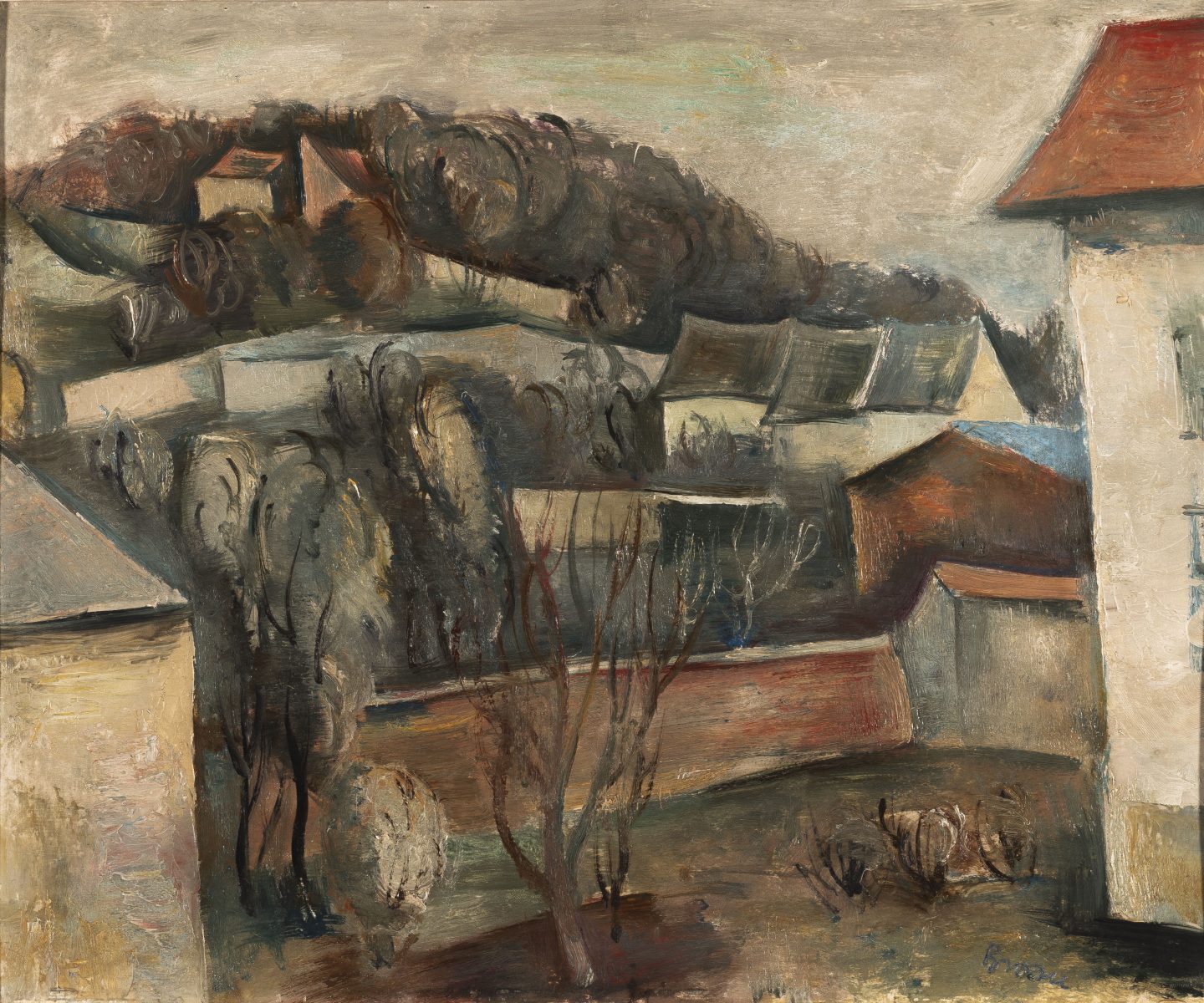
Landscape with Houses
|
no date
Bromberger, Dora
1881
Bremen (DEU)
-
1942
Minsk (BLR)
In Dora Bromberger we encounter yet another artist who was left defenceless against the National Socialists. As the daughter of the Jewish composer and pianist David Bromberger (1853–1930), she and her sister Henriette (1882–1942) and brother Siegfried (1879–unknown) grew up in a liberal, bourgeois home. The Brombergers had their three children baptised in Bremen’s Lutheran cathedral on 26 March 1888. What motivated them to take this step can no longer be reconstructed, though conversion to Christianity often came about as a result of social pressure or the desire for equal rights.
Dora had aspirations to become an artist even as a child. She attended several painting schools, including the progressive art school in Munich run by Hans Hofmann (1880–1966), who would later become an Abstract Expressionist. She continued her studies in Paris, then the world’s flourishing art capital, where she drew inspiration from the latest avant-garde developments. Returning to her native Bremen in 1923, Bromberger soon won recognition as an artist. She had exhibitions at the Kunsthalle and the Graphisches Kabinett and some of her works were shown in other cities, too, including Berlin in 1927 and Nuremberg in 1928, where she was among the contributors to the exhibition Deutsche Kunst der Gegenwart (German Art of the Present). While she had a marked preference for Expressionist-style landscapes and still lifes, most of them painted in watercolour or oil, she also cultivated a calmer style, as evidenced by her Landscape with Houses, reproduced here. Having become a member of the Gemeinschaft Deutscher und Österreichischer Künstlerinnenvereine aller Kunstgattungen (Association of German and Austrian Societies for Women Artists in all Disciplines, GEDOK) in 1928, she and her sister Henriette, who was a pianist of some renown, began organising salons that they called “Lichte Sonntage” (Light-Flooded Sundays) at their parents’ home.
But the National Socialists’ seizure of power abruptly put an end to all that. Excluded from their respective professions by the racist laws of 1935, the sisters became increasingly isolated. They rarely left home, and when their brother Siegfried emigrated to Cuba in 1939 they bid him farewell with a heavy heart. Meanwhile, Dora was still creating works of art, even if only out of discarded porcelain and cloth remnants.
Despite having been baptised forty years earlier and being in possession of burial plots in a Christian cemetery in Riensberg, the Brombergers were not spared persecution. When one of the sisters received an evacuation order in October 1941, they decided to embark on the impending journey into the unknown together. The National Socialist authorities thereupon sold their house – the home in which they had lived the greater part of their lives. They were deported on a transport that left Bremen’s Lloyd Station in the early hours of the morning for a “death camp”[BS1.1][JC1.2][CW1.3] near Minsk. A friend who came to say goodbye was able to give the artist a woollen blanket and some provisions for the journey. After several days, Dora and Henriette arrived at the Minsk ghetto, where they were housed in the most appallingly squalid conditions and exposed to the extreme cold of the winter of 1941–42. As forced labourers, both had to help out at the nearby Wehrmacht field hospital, where their mundane tasks – peeling potatoes, for example – did at least give them sporadic access to food. When the field hospital was disbanded in June 1942, Dora was sent to the extermination camp Maly Trostenets and murdered. Weiterführende Informationen finden Sie in unserem Sammlungskatalog „Wir werden euch nicht Vergessen. Die Verlorene Generation. Ihre Kunst. Ihre Geschichten“. Dieser ist here erhältlich.
artworks
Landscape with Houses
Oil on wood
42 × 52 cm
no date